What is the Community Coach initiative trying to achieve?
The Discovery Coast, including Agnes Water, the Town of 1770 and Miriam Vale, is a small, dispersed rural and coastal community. Long distances to services, limited access to non-clinical mental health support and social isolation can leave people turning to their GP because they are lonely, socially isolated, struggling with their mental health or simply finding everyday life difficult. Medical treatment is not necessarily the whole answer.
The Community Coach provides trauma-informed, one-to-one wellbeing support through personalised planning, health literacy, self-care strategies and supported introductions to local groups and services. It is deliberately human in scale: one coach building trust and walking alongside people as they take steps towards connection, confidence and participation.
What did you want impact measurement to help you understand?
We wanted to move beyond reporting referrals, appointments and connections to community groups. Those figures showed what the Community Coach had done, but not whether participants’ lives had changed.
We wanted to know whether people felt less isolated and more connected, better able to cope and manage day-to-day life, and more hopeful about the future. We also wanted to understand the social value of those changes relative to the program’s cost.
Just as importantly, we wanted evidence we could use to improve delivery: who was experiencing change, what appeared to be helping, whether the changes lasted and where the program could be strengthened.
We began by developing a Theory of Change that mapped the need, the support being delivered and the outcomes we expected participants to experience. This helped us separate activities from outcomes and select the ASVB questions and standardised wellbeing measures we would use to test whether those changes occurred.
How did you build measurement into day-to-day delivery?
We built the outcome questions into program touchpoints staff were already using to check-in with participants and review their progress.
Participants completed baseline questions at intake. The selected ASVB questions sat alongside the standardised wellbeing measures required by the funder and were repeated during the program, at exit and after participants had left.
This allowed us to compare each participant’s responses over time, see where change was emerging and begin to understand whether it was sustained. Because the questions were built into existing conversations, measurement became part of normal delivery rather than a separate exercise.
What happened when the evidence challenged the plan?
The evidence showed us that overall wellbeing was improving, but the outcomes we had selected did not explain the full pattern. When we looked more closely and spoke with the Community Coach, relief from depression and anxiety stood out earlier than expected. Participants described feeling less anxious about going out, finding daily tasks easier and feeling more optimistic about life.
We had not included the exact ASVB question for that outcome at intake, so we could not claim it had been measured directly. For this first group, we used relevant questions from the broader wellbeing survey as a transparent proxy. The gap showed us what to measure directly in the next cycle.
That was the learning loop in practice. The framework was not there to prove our original assumptions. It helped us see what we had missed and strengthen the evidence while the program was still developing.
What did the early valuation tell you?
The first result didn’t give us a final answer. It gave us a baseline and clearer planning questions.
Evidence from 13 participants indicated meaningful changes in mental health and community connection. For the early calculation, we used the portion of annual delivery costs covering mid-March to the end of July, plus set-up costs. This aligned the costs with the period in which the outcomes were measured.
We then tested two separate scenarios against the full-year program cost. The first applied the early achievement rates and three-month outcome duration to a larger group, indicating that social benefit could begin to exceed cost at around 31 participants. The second kept the original 13 participants and tested what the value might look like if their changes lasted for 12 months.
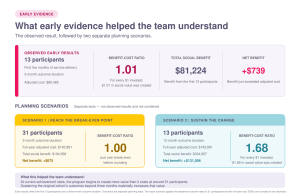
Each scenario changed the modelled result for a different reason.
Increasing participant numbers showed that the estimated social benefit could begin to exceed the full-year program cost at around 31 participants. This focused our attention on the referral pathways and consistent delivery needed to reach more people.
Extending the outcome duration showed how much the result depended on participants sustaining change. This prompted us to examine which parts of the support appeared to contribute most, whether improvements continued after participants left and what ongoing or follow-up support might help maintain them.
The scenarios were not predictions or a verdict on the program. They turned the early result into practical questions for the next phase of delivery and measurement.
How did putting a value on change help the team?
The team already knew from working with participants that the Community Coach was making a difference. Referrals, appointments and community connections showed what the team had delivered, but not what those activities meant in someone’s life. ASVB social impact values gave the team a consistent way to make that change visible.
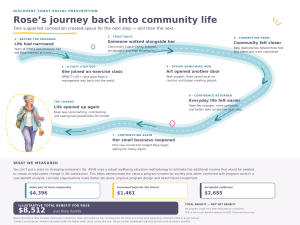
Rose’s journey brought that distinction to life. Her movement from isolation towards community participation, renewed confidence and reopening her small honey business showed how one supported step could create space for the next. Applying values to outcomes such as local community connection, hope and resilience helped the team communicate why those changes mattered.
The values were not intended to reduce Rose’s experience to a number. They gave the team a way to show the significance of the changes it was supporting and reinforced why measurement needs to look beyond activity counts to what happens next for participants.
What will you do with what you have learned?
For future participants, we will include the exact ASVB question for relief from depression and anxiety from intake through to follow-up. We will also continue following up after people leave so we can understand whether improvements in mental health, resilience and community connection last, and what parts of delivery help sustain them.
The early participant evidence and scenario testing also helped give us confidence in the program’s potential if it was delivered consistently over a longer period.
Continuing the program would allow us to reach more people, refine the delivery model and collect stronger evidence about which outcomes last. That evidence can be used feed back into the Theory of Change and guide the next round of program decisions.
The first impact measurement cycle changed what we measure, informed how the program develops and supports decisions on where to continue investing. Further measurement cycles would allow us to test whether those decisions create stronger, more lasting outcomes for people.
Measure. Learn. Improve. Then measure again.
What could your early evidence help you improve?