CASE STUDY: MORE THAN A MOMENT – REVEALING THE FULL IMPACT STORY

Posted on the 18th June 2026

How Disability Sports Australia used participant data, stakeholder insights and research evidence to understand the full social value of Abilities Unleashed.

THE CHALLENGE

Disability Sports Australia‘s “Abilities Unleashed” program was designed to do more than provide a one-day sporting experience.

Delivered nationally across 28 events, the program introduces people with disability to inclusive and adaptive sports, helping participants discover activities they enjoy, build confidence and understand what opportunities are available to them within their local community.

The intended impact is not simply participation on the day. The real goal is to create a pathway into ongoing participation in sport and recreation.

Disability Sports Australia (DSA) had great data, around the number of sessions provided, how many attendees and how many volunteers, but like many organisations, they wanted to understand and show the true social value being created through the program. However, an important question emerged early in the process:

How do you measure long term impact when collecting long term data is difficult?

Many of the participants rely on carers, support workers or family members to assist with surveys and evaluation activities. While collecting immediate feedback was achievable, repeated follow up surveys created practical challenges and risked adding burden to participants and carers.

This meant Disability Sports Australia faced a dilemma common across disability, aged care and community services:

The outcomes that are easiest to measure are often not the outcomes that matter most.

USING THE ASVB TO DEMONSTRATE ACTUAL AND POTENTIAL SOCIAL IMPACT

While DSA had strong participation data and clear evidence that the event was connecting people with disability to local sport and recreation opportunities, demonstrating the broader value of these outcomes remained a challenge. Many of the most significant benefits occur after the event itself, as participants go on to join clubs, become more physically active, build social connections, and improve their wellbeing over time.

This is where the Australian Social Value Bank (ASVB) came in. DSA joined the ASVB Grant Program, working alongside other organisations seeking to better understand and communicate their social impact, with dedicated support from the ASVB team. Through this process, DSA was able to demonstrate not only the value of the outcomes directly evidenced through its existing data collection, but also the likely social value generated through the downstream impacts of the program. This provided a practical way to quantify the broader benefits created when people with disability are connected to local sport and recreation opportunities and supported to participate in their communities.

MEASURING WHAT WE COULD OBSERVE

The first step was to focus on outcomes that could be directly evidenced through participant data.

Working with DSA, the ASVB team identified two outcomes that best represented the immediate change experienced by participants:

  • Increased opportunity to engage in preferred physical activity
  • Participation in physical activity by people with disability

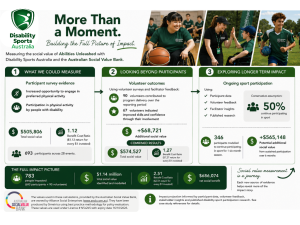
Across the 693 participants who attended an Abilities Unleashed event and completed the survey, the analysis demonstrated significant immediate social value created through participation in the program.

The valuation identified:

  • $505,806 in total social value
  • $52,206 net social benefit
  • Benefit Cost Ratio of 1.12 or $1.12 return for every dollar invested

While these results demonstrated substantial value being created through the events, both DSA and the ASVB team recognised that they were unlikely to represent the full impact of the program. The survey data captured the immediate outcomes experienced by participants on the day, but the program was designed to create broader and longer lasting change.

To better understand this wider impact, DSA and ASVB reviewed additional data sources collected by DSA facilitators including volunteer and co-ordinator feedback responses. This led to the identification of further social value created through volunteer involvement and the development of a projection model to estimate the likely value generated when participants continue engaging in sport, recreation and community activities following the event.

Together, this additional analysis helped create a more complete picture of the social value generated by Abilities Unleashed. It highlighted the importance of combining participant data, stakeholder insights and program knowledge to better understand the full impact of a program and the value it creates over time.

LOOKING BEYOND PARTICIPANT SURVEYS

As DSA and the ASVB team explored additional sources of evidence, it became clear that the value created by Abilities Unleashed extended beyond the participants attending the events.

One important area of impact was the program’s volunteer workforce. Abilities Unleashed relies on volunteers to support event delivery, many of whom gain valuable experience, skills and confidence through their involvement in inclusive sport and recreation programs.

Using volunteer feedback DSA identified:

  • 90 volunteers contributing to program delivery over the reporting period
  • 67 volunteers indicating improved skills and confidence through their involvement
  • $68,721 in additional social value

This demonstrated that the value created by Abilities Unleashed extended beyond event participants alone. In addition to supporting people with disability to participate in sport and recreation, the program was also creating value for volunteers by building skills, confidence and experience in the delivery of inclusive sporting opportunities.

By incorporating volunteer outcomes alongside participant outcomes, DSA was able to develop a more complete picture of the value being created through the program and ensure that important benefits were not left out of the analysis.

When combined with the participant outcomes identified through the event surveys, the analysis demonstrated:

  • $574,527 in total social value
  • $120,927 in net social benefit
  • Benefit Cost Ratio of 1.27

LOOKING BEYOND IMMEDIATE OUTCOMES

While the participant and volunteer analyses demonstrated significant social value, DSA knew these results were still only capturing part of the impact created through Abilities Unleashed.

The program is not designed simply to provide a one-day sporting experience. Its purpose is to introduce people with disability to inclusive sport and recreation opportunities, build confidence to participate, and connect participants with pathways for ongoing involvement in their local communities.

Through program delivery, DSA consistently observed participants discovering sports they had never previously considered accessible, learning about local clubs and programs, and expressing interest in continuing their participation beyond the event itself.

The challenge was that this longer-term participation was not being systematically tracked. While DSA had strong evidence that the events were creating pathways into ongoing participation, the organisation did not yet have a practical way to collect follow up data months after the event. This is a common challenge for organisations working with underrepresented cohorts, where repeated surveys can place additional demands on participants, families and carers.

As a result, the valuation could confidently demonstrate the immediate value created through participation and volunteering, but there was still an important question to explore:

What additional value might be created if participants continued engaging in sport and recreation after attending Abilities Unleashed?

PROJECTING THE VALUE OF ONGOING PARTICIPATION

To explore the longer-term impact of Abilities Unleashed, DSA and the ASVB team developed a projection model to estimate the value that could be created if participants continued engaging in sport and recreation after attending the event.

While the participant surveys provided robust evidence of immediate outcomes, the purpose of Abilities Unleashed is not simply to create a positive experience on the day. The program is designed to connect people with disability to ongoing sporting opportunities, increase confidence to participate, and create pathways into community sport and recreation.

Like many organisations working with underrepresented cohorts, DSA faced practical challenges in collecting long-term follow-up data. Rather than ignoring these potential outcomes, the project drew on the best available evidence to understand what may happen next.

The model combined:

  • Participant survey results
  • Program facilitator observations and experience
  • Disability Sports Australia’s understanding of participant pathways
  • Published research on disability sport participation and sustained engagement
  • Conservative and transparent assumptions

Research commissioned by the Australian Sports Commission1 found that many people with disability want to participate in sport and recreation but face barriers including accessibility, transport, cost and availability of suitable opportunities. This suggests that low participation rates are often driven by barriers rather than a lack of interest.

Additional research2 examining participants in the HandbikeBattle program found that more than 90% of participants remained engaged in sport between 1.5 and 5.5 years after completing the program. Researchers concluded that structured sporting experiences can support sustained participation through confidence building, skill development, peer support and social connection.

A separate study of adaptive sports participation among adults with stroke3 found that adaptive sports programs were safe, feasible and well accepted, resulting in increased physical activity levels among participants. Participants identified health benefits, fitness and enjoyment as key motivators for ongoing participation.

Together, this evidence suggests that when barriers are reduced and participants are connected with appropriate opportunities, ongoing participation in sport is a realistic and achievable outcome for many people with disability.

Drawing on this research, together with DSA’s experience supporting participants into local sporting opportunities, a conservative assumption was adopted that 50% of participants would transition into ongoing participation in sport or recreation for one 6 month season, following the event.

The 50% participation assumption was intentionally selected as a conservative midpoint, recognising both the strong evidence that participation can be sustained when barriers are removed² ³ and the practical barriers that continue to limit participation for many people with disability.¹

Under this scenario:

  • 346 participants would continue participating in sport
  • $565,148 in additional social value could be created

When combined with the participant and volunteer outcomes already identified, the analysis demonstrated:

  • $1,139,674 in total social value
  • $686,074 in net social benefit
  • Benefit Cost Ratio of 2.51

BRINGING THE FULL PICTURE TOGETHER

By combining participant outcomes, volunteer impacts and a conservative projection of ongoing participation, Disability Sports Australia was able to develop a more complete understanding of the value created through Abilities Unleashed.

The process demonstrated that social value measurement is not simply about calculating a final number. It is about understanding how change occurs, who experiences that change, and how different sources of evidence can be brought together to tell a more complete impact story.

The initial participant surveys provided robust evidence of the immediate value created through the events. Additional stakeholder engagement highlighted the contribution volunteers were making and the benefits they were experiencing themselves. Discussions with program facilitators then identified an important question that could not yet be answered through existing data alone: what happens after participants leave the event?

Exploring this question through transparent and conservative forecasting allowed DSA to better understand the potential longer-term value of creating pathways into ongoing sport and recreation. While these projected outcomes require future verification, the exercise highlighted both the likely scale of impact being created and the importance of continuing to strengthen data collection over time.

Rather than producing a single social value figure, the project helped build a richer understanding of how Abilities Unleashed creates value for participants, volunteers and the broader community. In doing so, it demonstrated that impact measurement is an ongoing journey of learning, refinement and continuous improvement.

LESSONS FOR OTHER ORGANISATIONS

  1. Understanding impact requires listening to all stakeholders

Participant surveys provided valuable evidence about the immediate outcomes experienced through Abilities Unleashed. However, discussions with Disability Sports Australia highlighted that important changes were also occurring for volunteers and through participants’ ongoing engagement with sport beyond the event itself.

By engaging with different stakeholders, the analysis was able to identify impacts that would not have been visible through participant survey data alone. This reinforced a key principle of social value measurement: understanding value requires listening to the people who experience change and considering how different groups may be affected by a program.

  1. Different forms of evidence answer different questions

Participant survey data helped demonstrate what had already been achieved through the program. Volunteer feedback provided insight into benefits experienced by another stakeholder group, while projection modelling helped explore the potential value created through ongoing participation in sport and recreation.

Together, these different forms of evidence provided a more complete understanding of program impact than any single source could have achieved on its own.

  1. Social value often extends beyond the primary beneficiary

The analysis showed that value was being created not only for participants, but also for volunteers who gained skills, confidence and experience through their involvement in the program.

  1. Research can strengthen impact measurement

Not every outcome can be measured immediately. Organisations often need to make decisions before long-term data becomes available, particularly when working with cohorts where follow-up data collection is challenging.

In these situations, published research, stakeholder insights and program knowledge can help organisations develop evidence-informed assumptions about likely outcomes. While these assumptions should always be transparent and conservative, they provide a practical way to explore potential impact and identify priorities for future evaluation.

For Disability Sports Australia, research on disability sport participation helped provide additional confidence that ongoing engagement in sport was a reasonable outcome to model, even though it had not yet been directly measured.

  1. Measuring impact is a journey

Perhaps the most valuable outcome of the project was not the final social value figure. It was the deeper understanding gained about how the program creates value, who experiences that value, and what evidence is needed to demonstrate it.

The project began with participant survey data, expanded to include volunteer outcomes, and then drew on stakeholder insights and published research to explore longer-term impacts. Each step added another piece to the story.

For Disability Sports Australia, the ASVB process provided a practical framework for bringing together multiple forms of evidence to communicate both demonstrated and potential impact. It also identified clear opportunities for future data collection, allowing the organisation to continue strengthening its understanding of the value created through Abilities Unleashed.

 

REFERENCES

  1. Australian Sports Commission. AusPlay Data Portal: Sport-related participation – frequency of participation. Accessed May 2026.
  2. de Groot S, Kouwijzer I, Valent L, et al. Sport participation after the HandbikeBattle: benefits, barriers, facilitators from the event – a follow-up survey. Spinal Cord Series and Cases. 2020;6:54.
  3. Nayak P, Mahmood A, Kumaran S, Natarajan M, Unnikrishnan B, Solomon JM. Adaptive sports for promoting physical activity in community-dwelling adults with stroke: A feasibility study. Journal of Bodywork and Movement Therapies. 2021;28:341–347.
Learn more about our Sports Values here

Read more posts...

MEASURING THE SOCIAL IMPACT OF SPORT:

INTRODUCING THE ASVB SPORTS WELLBEING VALUES Sport creates significant social, health and wellbeing benefits, but until now many organisations have struggled to consistently measure and communicate that impact beyond participation numbers. In response to this...

Posted 08 May 2026

A SHARED APPROACH TO MEASURING THE VALUE OF SPORT

GIPPSPORT AND THE DEVELOPMENT OF SPORT AND YOUTH VALUES IN THE ASVB “We wanted to move beyond participation numbers and truly demonstrate the value of sport in our communities.” Karen Ferguson, Manager Partnerships and Programs,...

Posted 08 May 2026