How the National Council of Jewish Women Australia (NCJWA Victoria) used the Australian Social Value Bank to measure changes in mothers’ wellbeing and demonstrate the value of its Caring Mums program.
The value of a listening ear
How do you measure the value of feeling supported, building confidence and feeling empowered as a mother?
Pregnancy and early motherhood can be an isolating and overwhelming time. Caring Mums, a program of NCJWA Victoria, has supported over 1,000 mothers from 52 cultural backgrounds, providing free, non-clinical emotional support so mothers don’t have to navigate this transition alone.
Since 2011, Caring Mums has connected pregnant women and new mothers with trained volunteers who offer a consistent, compassionate and non-judgemental listening ear.
Through weekly visits for up to 12 months, mothers have space to talk openly, build confidence and feel supported as they find their own way through early parenthood.
The relationship is at the heart of the program. Having someone who turns up regularly and listens without judgement can help a mother feel less isolated, more connected and more confident in her parenting.
Behind each relationship is a carefully supported volunteer. Volunteers receive training and ongoing fortnightly supervision, providing a strong foundation for the emotional support they offer mothers.
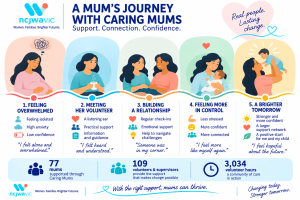
During the 2025–26 reporting period, 77 mothers entered Caring Mums, supported by 109 volunteers and supervisors contributing 3,034 volunteer hours.
But how do you demonstrate the value of support that is often personal, relational and difficult to express in numbers?
That was the opportunity for Caring Mums to use the Australian Social Value Bank (ASVB).
Moving beyond counting activities
Caring Mums already collected information about participants’ experiences. Its intake and closure data offered insight into mothers’ anxiety, parenting confidence, isolation and support networks.
Working with the ASVB team, NCJWA explored how this existing information could show what was changing for mothers, rather than simply how many people were supported.
Making existing data work harder
Three outcomes were identified as closely aligned with the program: reduced parental stress, improved confidence and stronger social connection.
Existing questions were used as documented proxy measures, with clear rules for identifying meaningful improvement.
Matched intake and closure responses then provided evidence of positive change, which could then be connected to monetary wellbeing values through the ASVB Value Calculator.
![]()
What the data revealed
By comparing information collected when mothers entered and then completed the program, the Caring Mums team could measure positive changes in each mothers’ life.
In the first six-month analysis of 20 mothers with matched records, eight showed reduced parental stress, eight improved parenting confidence and 11 stronger social connection. Some mothers experienced more than one improvement.
NCJWA now had more than a record of support provided by the team of volunteers. They had the evidence of the difference that support was making for mothers across Victoria.
From measuring change to demonstrating wider impact
Caring Mums then used the outcomes observed in its existing data to estimate what similar improvements might mean across the full annual program.
Working with ASVB, the results from a further 30 mothers with matched intake and closure evidence were applied to the annual cohort of 77 mothers.
This provided an evidence-informed calculation of wider impact, that NCJWA could use to confidently communicate the social value they created across the full reporting year.
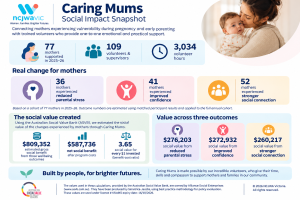
The annual valuation estimated $587,736 in net social benefit, with a benefit–cost ratio of $3.65 created for every dollar invested.
The accompanying snapshot shows the scale of the program and the social value associated with the outcomes mothers utilising the program achieved.
Putting the evidence to work
For Caring Mums, the valuation was not simply about producing a report.
The organisation has used its findings to help demonstrate the program’s benefits and support its efforts to secure additional funding.
The results have also become a communication tool. Together, the participant journey and social impact snapshot connect mothers’ experiences, volunteers’ contributions and the estimated value of the changes supported by the program.
They offer supporters, funders and the wider community a more complete picture of why the work matters.
This evidence can inform future funding applications, strengthen reporting and provide a starting point for improving how outcomes are measured over time.